
Knee problems have become very varied, particularly among athletes and people with knee osteoarthritis and cartilage wear.
Best Knee Arthroscopy Surgeon in Egypt
Do you have knee pain? Have you tried every medication and the pain is still there? Do you want to find a skilled doctor with enough experience in knee problems? Don't worry: today you will get to know the best knee arthroscopy doctor in Egypt, Prof. Dr. Yasser Reda, consultant orthopedic surgeon in Egypt, who holds many international and local certificates in this field. He also has a good reputation among doctors and among the patients he has treated, and he holds a very high standing thanks to his constant effort to keep up with everything new and learn about the latest devices that make patients more comfortable and reduce their pain, because his first and last goal is the patient's health, from the first consultation until full recovery.

When Is Knee Arthroscopy Needed?
There are many reasons why a doctor may decide on knee arthroscopy. The arthroscope is one of the latest tools for treating many health problems, and it is the best alternative to complex open surgeries that used to need months of recovery. The main problems treated with arthroscopy include:
- A torn cruciate ligament, especially the anterior cruciate ligament (ACL), as it is the most prone to injury.
- Meniscus tear.
- Kneecap (patella) instability with constant, severe pain.
- Tears and loose fragments of the knee's internal cartilage, and loose bone fragments as well.
- Problems in the joint lining (synovium).
- Acute synovitis.
- Damage to the bone surface of the knee and erosion of the articular cartilage.
- It is sometimes used to assess the degree of swelling and to find the cause of unexplained pain.

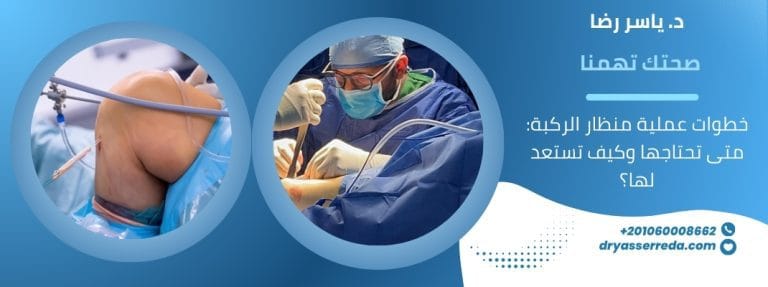
Steps of Knee Arthroscopy
Now that we have covered the health problems for which a doctor may perform knee arthroscopy, here are the steps Prof. Dr. Yasser Reda follows when performing this operation:
- Preparing for Surgery: Before the operation, the doctor asks the patient to fast for a set number of hours. The patient must also tell the doctor about all the medications they take, and have some lab tests and an ECG.
- Anesthesia: The patient is given local anesthesia in the knee, while some patients need regional (spinal) anesthesia to numb the lower half of the body.
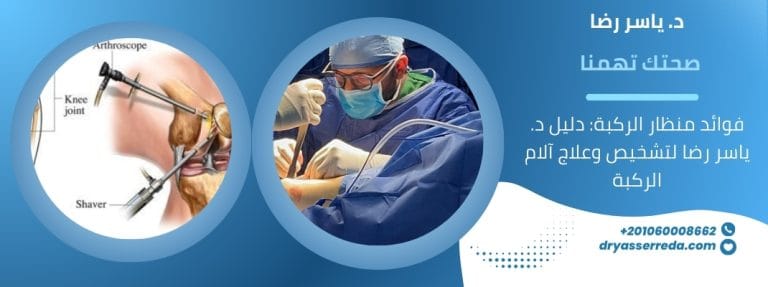
- Making the Incisions: The doctor makes small incisions beside the knee to insert the arthroscope, and injects sterile fluid inside to expand the space within the joint so the tissues can be handled more easily.
- Inserting the Arthroscope: The arthroscope, which is fitted with a camera, is inserted to view the cartilage and everything inside the knee.
- Fixing the Problem: Once the doctor has confirmed the patient's problem, he treats it: he trims or removes the torn cartilage, or repairs it if the problem is minor.
- Closing the incisions: After fixing the problem, the doctor closes the incisions with simple stitches, but only after draining the fluid injected at the start. A sterile dressing is then placed over the wound.

Benefits of Arthroscopy in Knee Surgery
Of course, arthroscopy offers the patient many benefits for knee problems that open surgery does not. The main benefits include:
- The doctor makes smaller incisions, which means smaller scars and less effect on the knee tissues.
- Less pain and a shorter operation than open surgery.
- The patient recovers faster from arthroscopy.
- The patient can leave the center or hospital on the same day as the operation.
- Patients can return to their normal lives shortly after the operation.
- The doctor can see inside the knee joint, which makes it easier to fix the problem with high precision.

Prof. Dr. Yasser Reda's Outstanding Experience in Knee Arthroscopy
Prof. Dr. Yasser Reda has extensive experience in knee arthroscopy and is one of the best-known orthopedic doctors in this field. He has performed a large number of these operations with impressive results, and with his wide experience and great skill he has made a real difference in the lives of patients who suffered from knee problems. Arthroscopy is one of the best modern techniques for reducing pain, and Prof. Dr. Yasser Reda has a highly professional approach to these operations, as shown by the successes we see with patients in real life. He also cares greatly about patients' comfort and their ability to return to their normal lives.
When Should a Patient See a Knee Arthroscopy Doctor?
There are many symptoms and signs that mean you should see an orthopedic doctor as soon as possible, and there is certainly no better choice than Prof. Dr. Yasser Reda, consultant orthopedic surgeon in Egypt. The most common of these signs and symptoms are:
- Inability to straighten or bend the knee for any reason.
- Constant pain with any effort, even a small one.
- A clicking sound when walking or moving, which points to a problem that needs treatment.
- Swelling or inflammation in the knee.
- In some serious cases, discharge may appear from the area around the knee.
- A high fever with no clear cause.
- Numbness or tingling in the limbs, which can progress to a clear loss of movement.
Are There Complications of Knee Arthroscopy?
Some complications are expected after any operation, but they are rare, especially if the patient follows all the instructions the treating doctor stresses, because this is a big part of the success of any operation, even a simple one. These complications include:
- Bruising and swelling around the knee.
- A superficial wound infection, though this is rare.
- A rise in body temperature; in this case, the patient should contact the treating doctor as soon as possible.
- Bleeding into the knee may occur, especially if the patient takes blood thinners.
- A delay in returning to daily activities.
To avoid all these complications, the patient must follow the doctor's instructions and take the medications and painkillers at the set times. It is also best to keep up with physiotherapy, because these exercises improve joint flexibility and help restore movement. Of course, these sessions and exercises should be done by specialists and at the time the doctor decides.
How long does knee arthroscopy take?
How long knee arthroscopy takes depends on the type of procedure, as complex operations take longer than simple ones. Here are the durations in detail:
- Diagnostic arthroscopy: may take from 15 to 30 minutes at most.
- ACL repair: may take longer, from 60 to 90 minutes.
- Meniscus repair: in most cases takes from 30 to 45 minutes.
- Other procedures take longer, depending on the patient's condition.
Is Knee Arthroscopy Painful?
No, not compared with traditional open surgery, which is painful. If there is any pain, it is mild and goes away once the patient takes the painkillers at the times set by the doctor, and it ends within a few days of the operation.
Does Knee Arthroscopy Require a Long Hospital Stay?
No. On the contrary, in most cases the patient leaves the hospital on the same day as the operation.
Does Knee Arthroscopy Leave Scars?
No. This is because the doctor makes small openings in the knee to insert the arthroscope, which leave only a small, superficial mark that fades within a very short time.
What Makes Prof. Dr. Yasser Reda's Experience in Knee Arthroscopy Stand Out?
Prof. Dr. Yasser Reda is one of the most skilled doctors with extensive experience in knee arthroscopy, thanks to the latest equipment he uses and the high precision he insists on in these operations.
How Long Is Recovery After Arthroscopy?
The patient needs a few days to recover from knee arthroscopy, but returning to normal life and exercise may take weeks.
In short, Prof. Dr. Yasser Reda is the best knee arthroscopy doctor in Egypt, thanks to his experience, his skill and his constant interest in everything new in orthopedic surgery. Patients who see him feel they are in safe, caring hands that provide the best medical care and services in every respect. Knee arthroscopy is also the best option for you, whatever your problem, to ensure a return to normal life and movement without pain as quickly as possible.